Employee vs. Independent Contractor House Cleaners: Why It Matters in Your Home
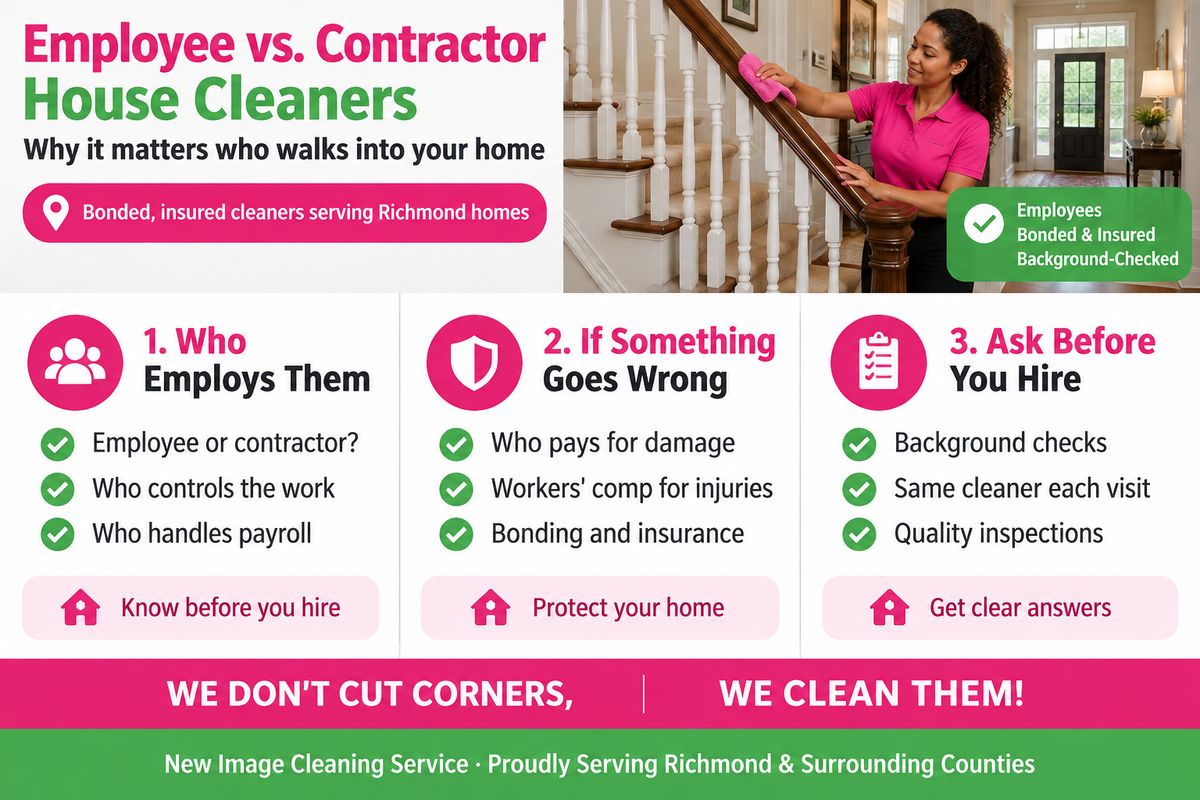
- Worker classification determines liability, insurance, and accountability; see IRS guidance on employee versus contractor.
- Employee model provides training, background checks, bonding, consistent cleaners, and company liability and workers' compensation (check Virginia Workers' Compensation Commission).
- Independent contractors and app platforms often lack liability, workers' comp, or bonds; platform protections may be limited or capped.
- Before booking ask: are cleaners employees, insured, workers' comp covered, bonded, background-checked, and will I get the same cleaner each visit?
When you book a house cleaner, you are inviting someone into your home, around your belongings, your kids and your pets. Most people compare price and availability. Far fewer ask a question that matters just as much: is the person who shows up an employee of the cleaning company, or an independent contractor working for themselves? The answer affects who is responsible if something breaks, who pays if someone gets hurt and whether you see the same trained person each visit. Here is how the two models differ and what it means for you as a Richmond-area homeowner.
What “Employee” and “Independent Contractor” Actually Mean
In the cleaning world, you will generally run into three setups:
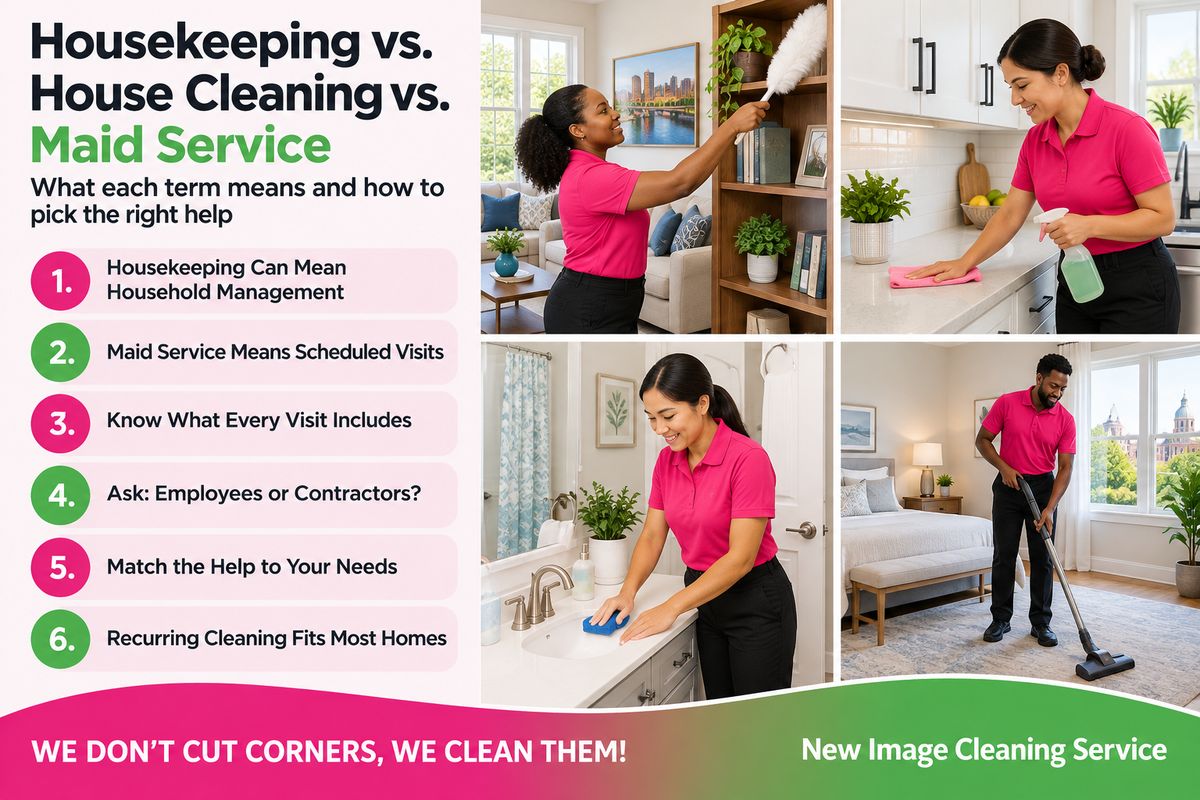
- W-2 employees of a cleaning company. The company hires, trains, schedules and pays the cleaner, withholds taxes and carries the insurance. You deal with the company, and the company is responsible for the person it sends.
- Independent contractors (1099 workers). The cleaner is self-employed. They may work on their own or take jobs through a company that treats them as contractors rather than staff. They set their own methods, supply their own tools and handle their own taxes and insurance, if they carry any.
- App and marketplace cleaners. A website or app connects you with an independent cleaner. The platform handles booking and payment, but the person who arrives is usually a contractor, not the platform’s employee.
The difference isn’t just a label. The IRS explains that whether someone is an employee or a contractor depends on the degree of control and independence in the relationship, looking at behavioral control, financial control and the type of relationship. Its guide, Independent contractor (self-employed) or employee?, is worth a skim. In short: an employer gets to direct how the work is done, and a contractor largely decides for themselves. That control is exactly what drives training, consistency and accountability in your home.
Who Carries Liability When Something Goes Wrong
Even careful cleaners have accidents. A vase gets knocked off a shelf, a cleaning product leaves a mark on a finish, a mirror cracks. What happens next depends on who the cleaner works for.
With an insured company that employs its cleaners, the company stands behind the work. Its liability insurance is there for covered damage caused during a cleaning, and you have one business to call to sort it out.
With an independent contractor, responsibility usually falls on the individual. Some carry their own liability coverage; many don’t. If they don’t, you may be left negotiating directly with the person, absorbing the cost yourself or turning to your own homeowner’s insurance.
With a marketplace app, read the fine print. Some platforms offer limited protection programs with conditions and caps, and many make clear they are a booking service, not the employer. Know what is covered before the first visit, not after something breaks.
Workers’ Comp: What Happens If a Cleaner Is Injured in Your Home
House cleaning is physical work. Cleaners climb step stools to reach ceiling fans, carry supplies up and down stairs and work on wet floors. Older Richmond homes in the Fan and the Museum District often have steep, narrow staircases, which add their own risks. Injuries are not common, but they happen.
Workers’ compensation insurance pays for medical care and lost wages when an employee is hurt on the job. When a cleaning company employs its cleaners and carries workers’ comp, an on-the-job injury in your home is handled through the company’s coverage. In Virginia, the system is overseen by the Virginia Workers’ Compensation Commission, which publishes employer coverage requirements and offers an online insurance coverage search.
Independent contractors are generally responsible for their own coverage, and many self-employed cleaners don’t carry it. If an uninsured cleaner is injured at your house, the question of who pays for that injury can become complicated, and it may end up involving your homeowner’s policy. Rules vary by situation, so if you are hiring an individual directly, it is worth asking your insurance agent how your policy would respond.
Bonding and Background Checks
Insurance covers accidents. Bonding addresses a different risk: theft. A bond is a form of protection a cleaning company purchases so that customers have recourse if an employee is found to have stolen from them. It is something businesses typically carry for their staff; individual contractors rarely do.
Background checks matter for the same reason. When a company hires employees, it controls the hiring process and can screen every person before they are sent to a home. With contractors and app-based cleaners, screening varies widely. Some platforms run checks, some leave it to the individual and some rely mainly on customer ratings.
If you are searching for bonded and insured house cleaners, look for a company that can confirm all three: the cleaners are bonded, the company is insured and every cleaner is background-checked before they enter your home.
Training, Consistency and Accountability
This is where the employee model shows up in everyday results, not just in worst-case scenarios.
- Training. A company that employs its cleaners can teach a consistent method: what gets cleaned, in what order and to what standard. Contractors may be skilled, but the company sending them generally can’t direct how they work.
- The same cleaner each visit. With employees, a company can assign the same cleaner to your recurring visits. That person learns your home, your preferences and which surfaces need special care. With marketplace apps, you may see a different face every time.
- Quality checks. Employers can send supervisors to inspect work and correct issues. With contractors, there is often no one checking.
- Coverage when someone is out. If your regular cleaner is sick or on vacation, a company with a staff can typically arrange coverage. An individual contractor may simply have to cancel.
Consistency matters most on recurring service. If you have a weekly or biweekly schedule, the value comes from a home that stays at the same standard visit after visit, which is much easier to deliver with trained staff who know your house.
Questions to Ask Before You Hire
You don’t need to be an expert in employment law to protect yourself. Ask these questions before booking, and listen for clear, direct answers:
- Are your cleaners employees or independent contractors? A company that employs its cleaners will say so without hesitation.
- Do you carry liability insurance, and can you provide proof? A certificate of insurance is a reasonable request.
- Do you carry workers’ compensation for your cleaners? This protects you if someone is hurt in your home.
- Are your cleaners bonded? Ask what the bond covers.
- Do you background-check every cleaner before they are sent to a home?
- Will I have the same cleaner on recurring visits?
- Who checks the quality of the work? Ask whether supervisors inspect cleanings.
- What happens if I’m not happy with a clean, or if something is damaged? Get the process in plain language.
If you are still comparing companies on broader factors like services, scheduling and communication, our guide on how to choose the right house cleaning service in Richmond, VA covers those. And reading what other homeowners say is a good way to see how a company handles problems; you can read ours on our reviews page.
How New Image Cleaning Service Handles It
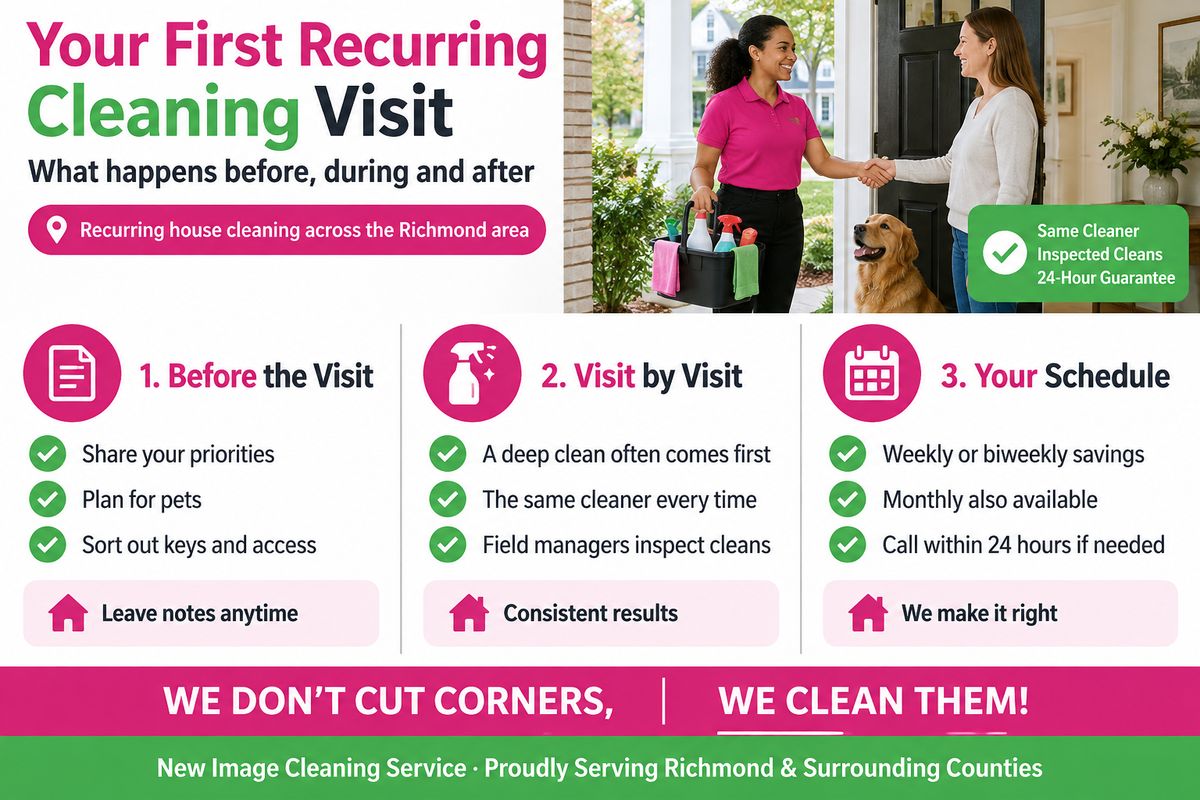
We chose the employee model on purpose. Every New Image Cleaning Service cleaner is our employee, not an independent contractor, and our cleaners are bonded, insured and background-checked. On recurring service, you get the same cleaner each visit, and our field managers inspect cleanings to make sure the work meets our standard. If something isn’t right, call within 24 hours and we will return to make it right at no additional charge.
We are locally owned and have served the Richmond metro for 20 years, from the city to Henrico County, Chesterfield, Midlothian, Glen Allen, Short Pump and Mechanicsville. Learn more about our Richmond house cleaning services, then call 804-239-6790 or request a free quote. Ask us any of the questions above. We are happy to answer them.
Share this article
Related Posts

Follow us
A quick overview of the topics covered in this article.